Bass Fishing at Kuboshiro Dam: Tackle Testing and Finally Landing a 52cm Beast!
 Admin

My alarm was set for 4:00 AM, and while I tried to get right up, pure exhaustion kept me in bed until about 4:30. Most local anglers are already on the water before dawn, so I was definitely running a bit behind schedule.
I got to the reservoir around 5:15 AM. Sure enough, another angler was already parked on my favorite point. I headed toward the opposite bank to scout an open spot, and fortunately, the first point was completely vacant, so I jumped right on it. A few years back, when I first moved back to Fukuoka, this was the exact spot where I rekindled my passion for bass fishing. I had taken a long break from bass, but after realizing how efficient baitcasters were while saltwater boat fishing, I decided to give bass another shot. On this very point, I caught my first bass in 15 years on a chartreuse crankbait.
Usually, the pre-spawn spring window is prime time. My original plan was to boat a nice fish early on and switch right back to saltwater, but I completely struck out during the peak season. Now it's already late May and well past the spawn. Determined to land one no matter what, I packed an assortment of soft plastics that I rarely throw. And because rumors have it that the bass have pushed out deep and require long-distance bombing, I even brought a shore jigging rod and some metal jigs for a super-heavy Carolina rig.
Between my kid's school sports day last weekend and heavy rain the weekend before, this was my first outing in weeks. On top of that, I had homemade crankbaits to test and a rod with newly rebuilt guides to evaluate, so I had quite a busy agenda ahead of me.
Right off the bat, a blunder: because I'd been busy crafting lures, I completely forgot the split-ring pliers I usually use to swap hooks. My prep work was clearly lacking, leaving my prototype lures completely hookless.

Using an ikejime spike and the tip of a pocket knife, I painstakingly managed to pry open the rings and rig the hooks. By the time I actually started casting, it was already around 6:00 AM. I even put the front treble on backward, but I just rolled with it.

Much to my surprise, the very first swim test exceeded my expectations. The bait swam cleanly and tracked right on target. It rides a little high due to high buoyancy, but that was intentional. I designed the profile to mimic a plump, flattened frog. It has an unconventional shape for a crankbait, which made me a bit nervous, but it dove down nicely to about 50 cm (around 1.5 feet). I worried that its fat profile might blow out, but on a slow retrieve, it displayed great presence with a tight, frog-like shimmy. Even burning it fast didn't break its tracking. This one's a winner! I'll do a separate build report covering its creation soon.

For this build, I tried a new method: splitting the body into three pieces to easily carve out a moving weight-transfer chamber, then bonding them together with a plastic-model masking putty to keep it watertight. It didn't leak a single drop. I'll share more details on that in a dedicated post.
Seeing how well it swam, I knew it had real potential. I wanted to bomb it out there and fish it hard, but it needed a quick field reinforcement first.
Because of the internal weight channel, clearance for screw eyes was tight, forcing me to use tiny ones from the 100-yen shop. If a heavy bass clamped down on them, they could easily pull out. As an emergency fix, I tethered them with nylon line so I wouldn't lose the hardware if a screw gave way.
I had given it a quick coat of black primer-surfacer just to seal the bare material, but the action was so addictive that I cast it non-stop. Eventually, the hook rash started wearing through the paint, risking water absorption, so I reluctantly benched it for the day.

Next up was testing the rebuilt rod with new guides. Shifting the stripper guide slightly further out noticeably improved casting distance and control. But as I got carried away bombing long casts—*snap!* The tip had broken before, and the repair sleeve gave out right where I'd reinforced it. Looking closely at the old blank's core, it appeared to be made of wood or some other brittle material—no wonder it snapped under load. I need to rebuild it using a proper carbon blank section next time. I should have plenty lying around the house.
Speaking of gear, I also repainted my reel! I detailed it with Gunpla decals and sealed the finish with UV resin followed by a compound polish. With two weeks away from fishing, I ended up spending all my spare time tinkering. Maybe that deserves its own post, too?

Next up was this topwater walker. The blank shape was finished a while ago, but I really wanted a handmade pencil bait to sling around. It's a prototype cast in UV resin. I'd been testing it coated only in matte black primer, but I recently gave it a quick airbrush job. I might have overdone the yellow—it ended up looking like a massive tropical reef fish.

I've tuned this bait through several water tests, so the action is rock solid. The only catch is that it's a sinking model. If I bomb a cast and get a nasty backlash, I risk losing it forever if it sinks out of reach, so I had to hold back on casting distance. Bulking up the profile made the resin too heavy to stay buoyant, leaving me with a sinking stickbait. The plan is to turn this into a true floating lure when I refine the production mold.

Word on the water is that the paddle-tail shad swimbaits local veterans relied on for years have stopped producing. Bass might finally be getting bored of standard plastics, which got me thinking that an unconventional presentation might trigger a reaction bite. That prompted me to pull out an old tuned Heddon Big Bud. Every time I landed a fish on it back in the day, I drew a star on the body. One mark is a triangle, likely from when a bass choked a trailer worm I had rigged on the back. Between the faded paint and hook rash, you can tell it saw serious combat. Landing four bass in a single season on such a wacky wake bait is pretty remarkable. Plus, Kuboshiro Dam has always been chartreuse territory for me, so it felt like the perfect choice.

I raised the rear blade hanger and swapped to a narrower blade years ago, shaving off the paint so that with every wobble, metal clattered against plastic with a loud, rhythmic clack—a tuning trick my fishing buddies taught me back then. The date August 31, 2002, is still visible in permanent marker on the side. It still made that glorious sound, but sadly, no takers today.
From there, I threw everything outside my usual comfort zone. I had high hopes for bombing deps Bull Flat 5.8" and 3.8" on the shore jigging rod, but blind casting long distance without clear structure in mind just felt aimless. Long bombing is fun when you know exactly where fish hold—like an offshore weed edge or a distinct drop-off. But I hadn't fished this area recently, and dragging a heavy rig agonizingly slow back to the bank was tedious and just not my style. Launching baits into open water hoping for a stray fish often just wastes valuable fishing time.
As an ultimate secret weapon, I rigged a 40g metal jig as a heavy Carolina sinker, trailed by a nail-weighted, wacky-rigged straight worm. It felt like the kind of high-impact rig that would prove whether a bass was home or not. A few casts in, it wedged hard into structure about 10 meters out. With PE 1.5 line, breaking off by hand wasn't an option, so I wrapped the braid around my landing net handle and pulled. The leader snapped clean near the terminal knot, officially ending my shore jigging experiment for the day.
After exhausting every gimmick and alternative approach, I realized nothing beats the raw fun of power cranking—machine-gunning casts with a baitcaster. So I switched right back to my bread and butter. Years ago, my very first bass upon returning to fishing in Fukuoka came on a chartreuse crankbait right here, giving me unshakable confidence in chartreuse patterns at Kuboshiro Dam. Lately, my go-to has been a Megabass Cyclone in Mat Tiger. In fact, just recently on this same color with the shallow squarebill, I hooked a giant bass only to drop it the exact second my thumb touched its lip.
I had both the shallow-runner and the deep-diver with me. Submerged weeds can occasionally snag your trebles around here, but the grass wasn't topping out near the surface, so I started relentlessly cranking the deep-diving Mat Tiger along the break.

I kept casting and burning it back. Just as the crank began ticking the bottom of the drop-off about 10 meters off the bank, I felt a subtle tick in the retrieve. The very next instant, the rod loaded up, and the bait was ripped sideways—hookset!
Haunted by my last heartbreak, I had brought my landing net and set it at the water's edge. But as I worked the rod to guide the fish's head toward the bank, the momentum carried it straight into the shallows. Thinking I had it pinned, I went to grab the leader, but the lure swung right toward my hand. I ended up grasping the crankbait itself—a terrifying second where a sudden thrash could have driven trebles deep into my palm. Luckily, I spotted the rear hook solidly buried in the gill plate, so I gripped the lure tight and slid the fish up onto the bank. It stayed completely calm, and I breathed a massive sigh of relief.
Early in the fight, it breached the surface and thrashed violently several times, which must have shaken the front treble free. Luckily, the rear hook caught firmly in the gill plate, saving the catch.
When fishing moving baits, I tend to lean into a sweep hookset rather than a violent snap, letting the rod load up under the fish's weight. But I wonder if that's the wrong call? Considering I lost one right at the bank last time, maybe I need to drive the hooks home with a more authoritative pop.

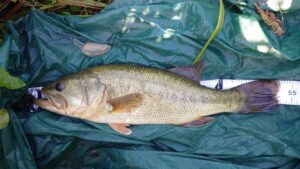
My first solid bass in what feels like forever! An impressive, thick, heavy specimen.

I laid down a picnic mat to treat the fish with care and put the tape measure down. Mouth closed against the zero mark: exactly 52 cm (about 20.5 inches)! A magnificent, starving trophy bass.

The lower lobe of the caudal fin was scuffed raw—a telltale sign of a post-spawn buck. His belly was completely hollowed out, suggesting he had spent weeks fiercely guarding eggs on the nest. With the fry having recently scattered, he was likely on the prowl for his first real meal in weeks when my crankbait crossed his path. In fact, right after releasing him, I spotted a small pod of about half a dozen tiny fry, barely a centimeter long. Chances are, they belonged to this proud dad.

He also had a noticeable lump on his head. Touching it felt strange, almost like a localized hematoma. For a second, I thought about lancing it with a needle to relieve the pressure, but I didn't want to risk introducing bacteria and causing an infection, so I left it alone. Likely another battle scar earned while defending his nest. Truly a warrior of a fish—thank you for the fight!
I can't tell you how relieved I am to finally break the dry spell. Now I can head back to the saltwater scene with a clear conscience... Then again, I really want to come right back to Kuboshiro and sling my handmade crankbaits all day!