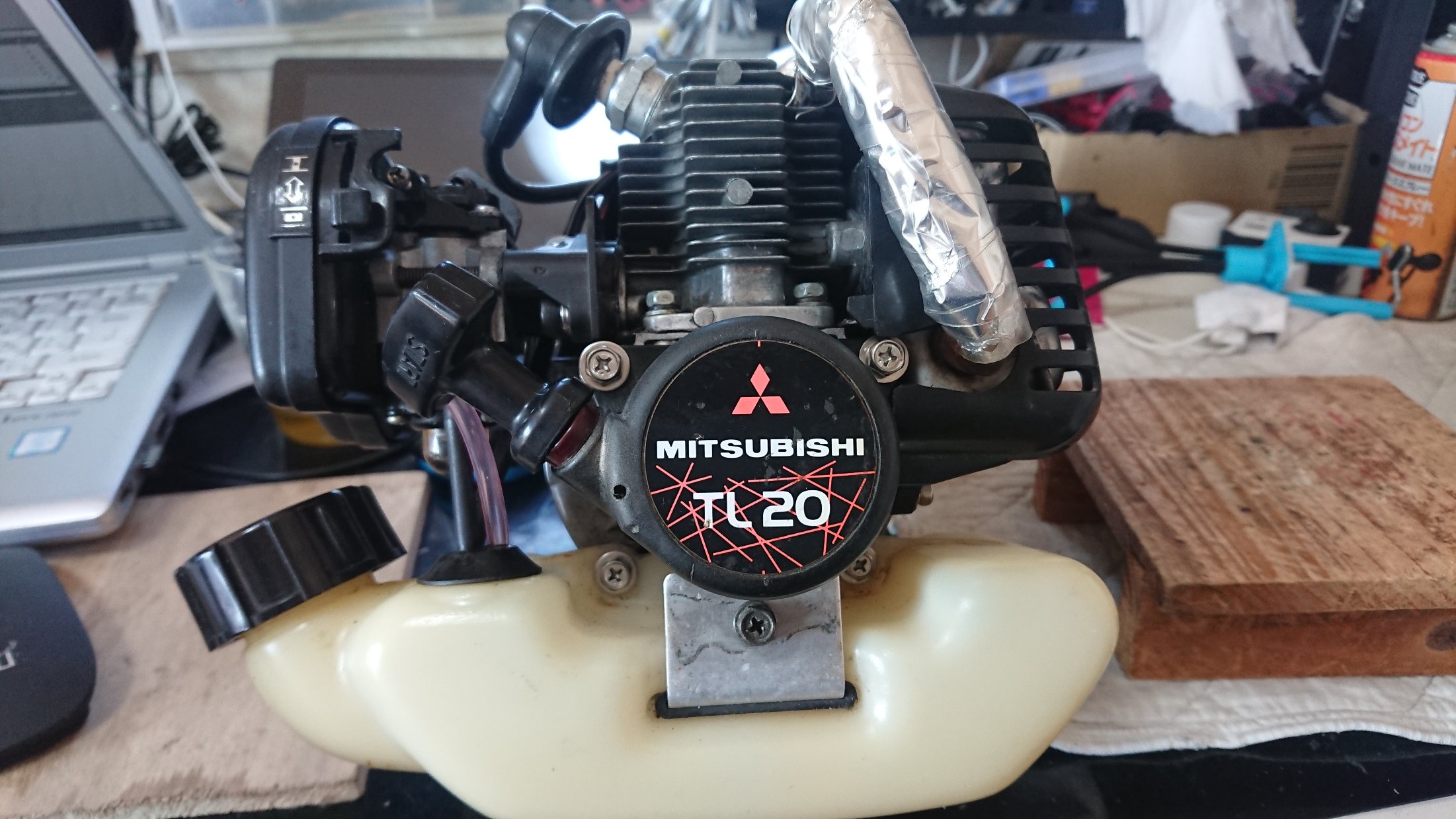
Fixing a Broken Recoil Starter: Reeling in the Spring and Repairing Cracks
 Admin
Last time, I finally got the engine running smoothly, but the recoil starter broke and the cord wouldn't retract. After years of struggle, the engine was running like a dream, and I was dying to wait a day and confirm if it was truly running great again—only to find I couldn't even start it! So, I decided to take it apart.
As I loosened the screws holding the reel, the spring suddenly popped out. It contained a long, watch-spring-like component. I figured out later that the center part of this coiled spring, which holds it in place, had probably come loose. It seemed like the spring had deformed due to age and being pulled over and over again.
The reel itself was already cracked when I received it. The cord hadn't been winding properly and felt awkward, so I decided to fix that at the same time.

However, this spring turned out to be a real pain. After doing a bit of research and mostly winging it, I hooked the outer edge of the spring onto a screw stuck into my desk and wound it by spinning the reel around. I managed to wind it up nicely.

Then, I secured the outer circumference with zip ties—three thin ones. I tried over and over to install it into the case like this, but every time I cut a zip tie, the spring would spring out violently. After struggling for about two hours in the middle of the night while drinking beer and scraping my fingers, it was completely impossible...

On another day—perhaps because I hadn't watched the reference video to the end, or couldn't find it when I looked again—I checked another site and realized that wrapping the zip ties vertically instead of horizontally makes them much easier to cut and pull out. Ah, makes sense! After winding it and locking the outer circumference just like I'd practiced many times before, I added the vertical locks.

After locking it in three places, I cut the outer zip ties.

I placed it into the case. Previously, cutting the outer zip ties here would cause the spring to burst out violently, but this time, cutting them one by one allowed the spring's diameter to expand gradually. It felt just right.

Then came the satisfying moment of getting it set! Oh man, I never want to do this again, so I had to be careful. The outer edge of the spring was hooked in place. Next, I needed to hook the inner edge onto the reel, but this part was deformed and wouldn't catch properly. I suspect this deformation was the original cause of it coming loose. I carefully reshaped it with pliers, attached the reel, and adjusted it so the inner hook of the spring would catch on the protrusion of the reel when turned.

When I inserted the reel and turned it to the left, the central hook of the spring caught nicely. I adjusted it a few times so it would catch and contract smoothly. I feel like I might have made these adjustments after already fixing the crack on the reel, just because I never wanted to mess with that spring again.

To fix the crack, I used a piece of plastic sheet I happened to have lying around—pulled straight out of a tool box from 20 years ago. I traced the outer circumference and the inner shape, sketched a rough outline in pencil, and then trimmed it with scissors, a hobby knife, and a file. Pretty clumsy work, I know. Circles are hard! But as long as it works, something like this should do the trick.

When I fitted it in, it looked pretty good. I was a bit worried about the strength, but it doesn't take heavy loads; it just needs to hold the cord in place. Once fitted, it seemed like it would hold. Coincidentally, rummaging through that same 20-year-old toolbox turned up a tube of G-Clear bond (amazing that it didn't dry up and stayed good for 20 years!). Since it's a rubber-based adhesive, I figured it would be perfect for plastic too, and happily used it. It bonded without any issues.

I put it in, adjusted the spring shape, turned it to catch on the reel hook, and then screwed it down. While binge-watching videos, I finally learned how to wind a recoil cord. You take the cord on the recoil reel,hook it into the notch,and wind it to the left using the cord. So, I went ahead and made a notch myself.
After winding it to a certain extent with the cord, you unhook the cord from the notch and let the spring tension pull it back. Repeating this a few times...in the end, winding it a bit extraso that some spring tension remains seems to be the way to go, as it keeps enough tension to prevent the spring hook from slipping out of the reel's notch. I actually had it slip out once and had to rewind the cord. Thank goodness the spring didn't pop out on me.

Next, maybe triggered by the recoil breaking—or perhaps this happened first—the mounting area for the recoil's one-way mechanism part was cracked. What do you even call this part? When the engine spins, it freespols, but when you pull the recoil, this part overtakes the crank and engages only then. This photo shows it before it broke; one side inside the spring was chipped. I repaired this using a screw.

It looks like this. I cut off the remaining broken piece, drilled a hole, and tapped a thread. M3, maybe? Since a bare screw would rub against the rotating part, I added a piece of rubber or silicone tubing I had lying around—probably scavenged from a fishing hook package. The photo shows me testing it by cutting it in half, but I ended up using the cut piece from the top right as well to make it fit at its original size.

Then, I installed it. Looks like it'll hold. It's battered, but still usable. This part, combined with the shape in the center of the recoil reel shown in the first half, creates the one-way clutch mechanism. Whenever I see mechanical engineering like this, I can't help but feel excited and impressed.

From a different angle.

Finally, I assembled the recoil reel, spring, cord, and case that I repaired earlier, pulled the cord, and—vroom! The engine started! OK! Tried it a few times and it was still OK! Back to normal, and the engine sounds great! Everything is fixed.
Alright, I'm feeling good, so next I'll gather my weed-clearing gear and go clear the path to my usual bass fishing spot. And while I'm at the fishing spot, I'll rev the engine and tune the fuel mixture.

