Adding Custom Grips to a Smartphone Controller
 Admin
I've been playing Monster Hunter Freedom Portable, but playing it on an actual PSP is rough due to the small screen, low resolution, and poor image quality, so I've been using a smartphone paired with a controller instead. At four times the resolution, it looks just as good as modern games.
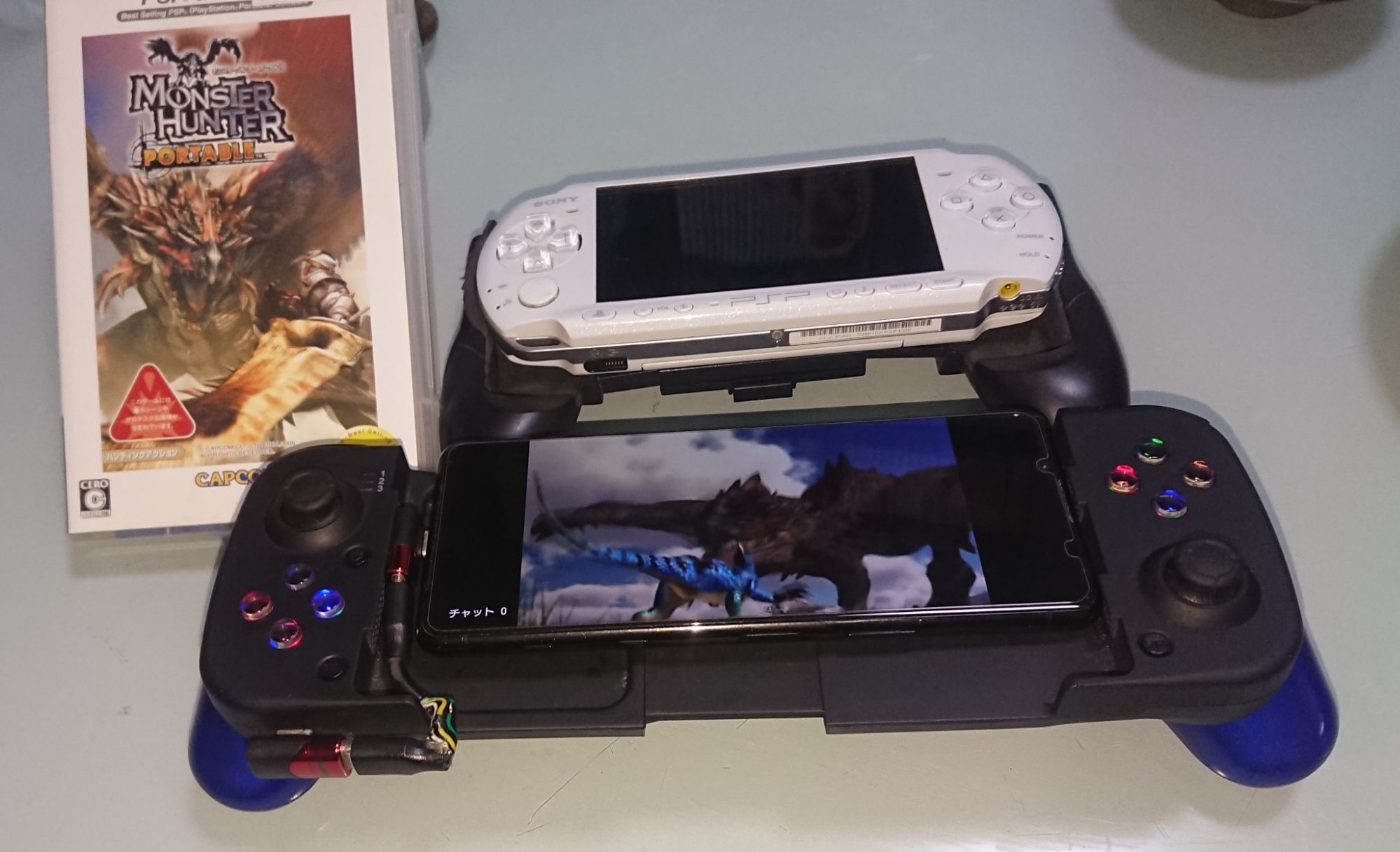
However, the smartphone controller lacks grips near the pinky fingers, making long gaming sessions uncomfortable. So, I used parts from a PS3 controller I'm familiar with to add grips to it. Now I can comfortably play Monster Hunter Portable for hours.

Through trial and error, I adjusted the size so that the geometry roughly matched a PS3 controller. But since the smartphone itself makes the whole setup quite large anyway, I didn't really need to stick so strictly to PS3 controller dimensions—making them a bit bigger might have been fine too.

Here is what the back looks like. It has a slightly irregular shape, but that's designed specifically to avoid interfering with the macro buttons on the rear.

Here's a shot from the front. Size-wise, it ended up fairly compact, about the same as the original controller. But since I'm not carrying it around on the go, prioritizing comfort and ease of use over compact size would have been just fine.

From here on are photos of the DIY process. First, I took a spare junk blue PS3 controller and aggressively cut away pieces with wire cutters around the marked areas. Once the shape was roughly right, I smoothed down the sharp edges with a file.

This was my initial concept, where I intended to make the grips pretty long vertically. However, after checking how the contact points fit together and considering the original shape of the PS3 controller, they ended up getting much smaller than this.

For the mounting method, I decided on screws. For now, I attached them using some spare wood screws I had lying around at home. I drilled through-holes and countersinks to drive the screws in.

First, I disassembled the smartphone controller to identify safe spots for driving screws—specifically ensuring that even if a screw protruded, it wouldn't touch the circuit board and cause a short circuit. Opening it up revealed that the circuit board was quite small and the inside of the lower grip area was mostly hollow, which was a relief.
This smartphone controller expands and contracts to fit the size of the phone. When I opened it up, I was surprised to find that the extension mechanism was built with a fairly sturdy leaf spring structure.

I drilled a hole around here, ran the screw through, and confirmed that it doesn't contact the circuit board. I also double-checked that it barely clears other plastic hook parts.

Here, I temporarily reattached the cover with the rear macro buttons removed and tested fitting the grip piece. I verified again from this angle that the screw won't contact the circuit board.

Since the grip area experiences quite a bit of force when holding it firmly, I also added a screw from the side to make it sturdy. Securing it at about two points seems to hold it well.

These two screw points are what support the grip.

However, the cut edges felt a bit rough against my palm, so I filled the gaps on the sides with UV resin. This reinforced the strength and improved the overall feel and comfort. I could probably add more resin and sand it down nicely, but for now, it works comfortably without any problems.

This is the opposite side.

There is still a gap at the bottom as well. I was thinking of filling this with UV resin too, but my middle and ring fingers actually fit into the notch quite nicely for a comfortable hold, so I'm leaving it as-is for now. That's all for now.

