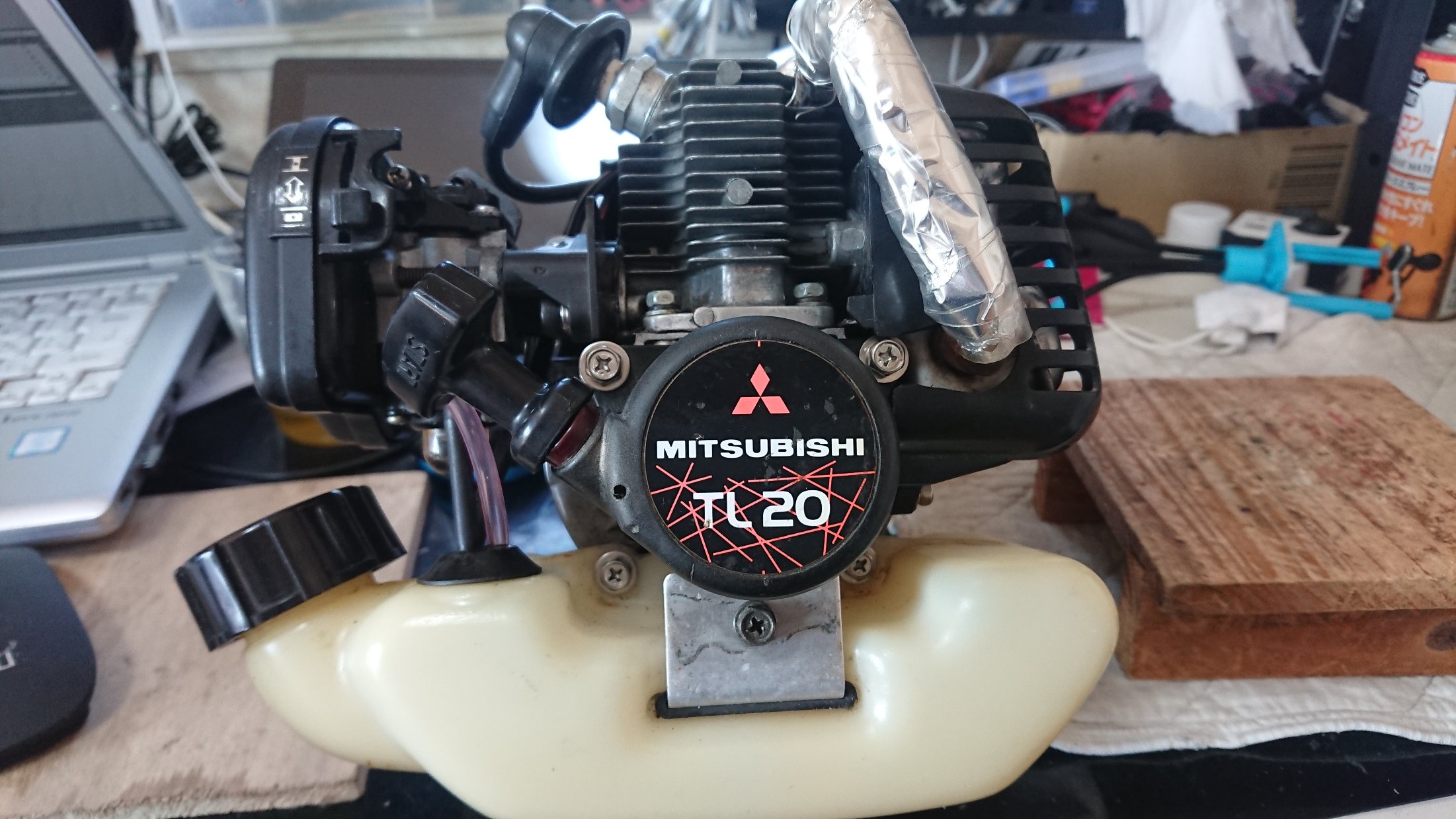
Mitsubishi Heavy Industries Tuaki Engine: Broken Piston Ring & Ordering Replacement Parts
 Admin
A senior colleague gave me a sluggish brush cutter engine that I had always wanted to use for motorizing a kayak, so I've been tinkering with and cleaning it up for fun. It's a great way to learn how 2-stroke engines work. After doing a carburetor overhaul and a few other things, it still wasn't running right. Over a year passed without touching it again, but on a whim, I decided to pull the cylinder off. After haphazardly clearing away some surrounding parts for cleaning, the cylinder came right off with just four screws.

Out popped a cute little piston. It had some carbon buildup, but it wasn't in bad shape at all—the kind of thing that would clean right up with a spray of carb cleaner.

Before, when I looked inside through the exhaust and intake ports, I saw vertical streaks and assumed it was blown. But it turned out those were just oil marks, and running my finger over them revealed no scratches.

The top of the piston had a fair amount of carbon buildup, but the sides and piston ring were clean. I tried filing down the top, but the cast texture was bumpy and rough right through. I could have ground it down completely, but that would lower the compression ratio, so I stopped at a reasonable point. There's a tiny protrusion on it—is that actually necessary? Would it be okay to file it off?

Carbon was caked onto the underside of the piston ring, causing it to stick firmly in place. While trying to wiggle it loose assuming it would pop right out, the carbon adhesive was so strong that *snap*—it broke!


The dimensions are roughly 31mm outer diameter, 1.2mm width, 28.8mm inner diameter, and 1.4mm thickness.
Here's where the real story begins, and things get interesting.
The engine is a Mitsubishi Heavy Industries Tuaki Engine (Meiki), model TL20PSD-407. It's an old-school 20cc engine that isn't sold anymore. By the way, "Meiki" seems to be an abbreviation like "Nagoya Kiki (Machinery)."
Searching online...
• MonotaRO: For a Maruyama 20cc (a common brand cheaply sold at home centers)—outer diameter 30mm, inner diameter 26.6mm... a bit too thick. Costs 714 yen + 500 yen shipping. Doesn't look like there are any other options.
• Amazon (Chinese seller): Found something promising—31mm, 2 pieces for 1,700 yen. Well, having two as spares should be fine.
It said shipping would take about 3 weeks, but I went ahead and ordered it anyway. It arrived in less than a week, but the size was completely wrong! The outer diameter was a whopping 33.4mm! I contacted Amazon's chat support and am currently negotiating a refund. Since return shipping to China is expensive—around 2,400 yen with tracking—I don't plan on returning them.
Just in case those didn't work out, I had been searching for ways to get genuine OEM parts. Eventually, I took these steps:
1. Found an inquiry form on the Mitsubishi Heavy Industries website and sent them a question.
Inquiry:
1. I want a piston ring for the TL20. Where can I get one?
2. Are there any compatible parts I can buy online? Would one for a Maruyama 20cc fit?
Response:
1. We do not sell them directly.
2. Here is a local service company, try contacting them:
Aichi Pump Industry Co., Ltd.
3. "TL20" is too vague, so it's best to provide the exact model number to the service company.
Surprisingly polite and helpful response.
From there,
I visited the website of Aichi Pump Industry Co., Ltd.

Why is it named "Aichi" when it's located in Nagahama, Fukuoka? I'll have to ask them about that next time.
Their main business seems to be fire truck-related equipment, but their site mentions they also handle agricultural machinery maintenance, and they even have order forms available.
Looking at the shop on Google Maps, it gave off a vibe geared toward dealers and service shops, which made me hesitate. The order form looked like it required a fax. A phone number was listed too, and worried that after agonizing for three days they'd just tell me to go through a dealer, I decided to just pick up the phone and ask.
When I called and explained that I was just an amateur wanting a piston ring and asked if it was available, they listened patiently and checked their stock using the engine model. It sounded like they had pistons, but maybe not the rings. However, based on my previous research looking at TL20 parts diagrams, engines from this era referred to it as a "top ring." When I mentioned it might be listed as a top ring, they instantly confirmed they had manufacturer stock!
TL20 Parts Diagram
http://www.danarm.co.uk/Engines/pdf/tl20.pdf
Top ring: 360 yen each. Would I pick it up at the shop, or have it shipped? They offered options even an amateur without a corporate account could use: 800 yen for shipping and a 640 yen cash-on-delivery fee.
Awesome, I'll go pick it up and grab some ramen while I'm out.
And that's how today's events unfolded. The adventure continues.
Still, now that my worries about sourcing parts for this gifted junk engine are gone, I can keep using it indefinitely.
My brush cutter itself is made by a company called Nikkari (with a Mitsubishi Heavy Industries Meiki engine), which is handled by only a very few agricultural equipment companies. In places like Asakura in the southern part of Fukuoka—where my senior colleague's family is from—agriculture is thriving, so local dealers make it easy. But northern Fukuoka has very little agriculture, meaning no shops nearby! I was briefly debating whether it would be easier to just switch to a modern engine available at major home centers, but as long as you can secure a reliable parts supply chain, you're golden.

